


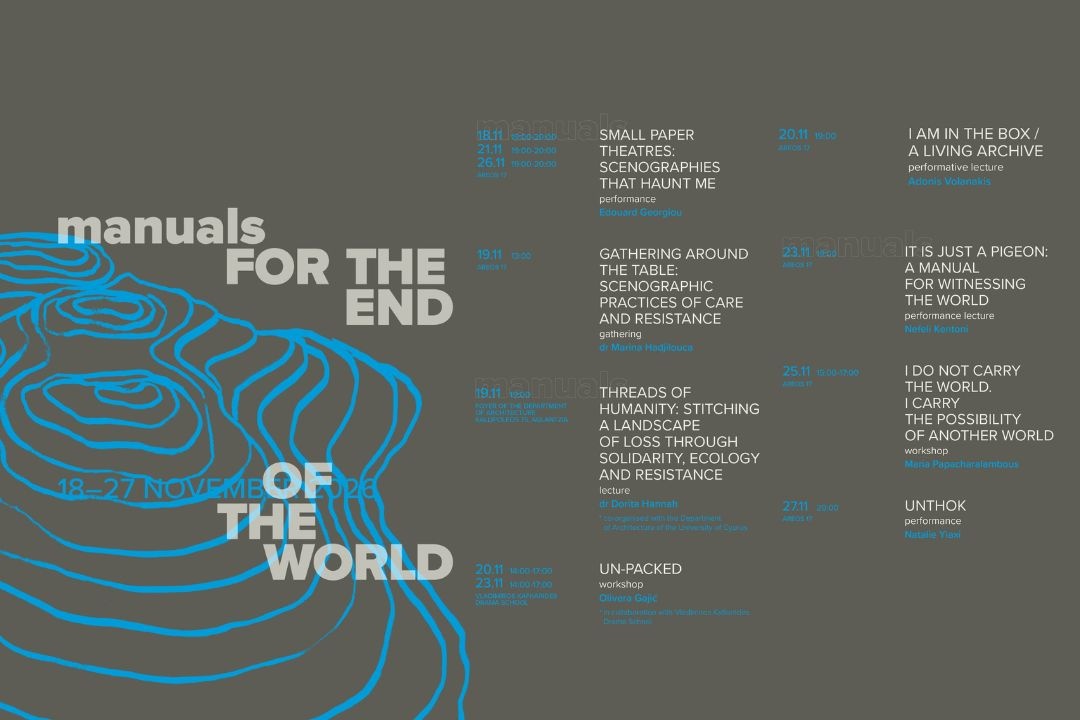
Parallel Programme │ Manuals for the End of the World
November 18 - 27, 2026, Nicosia, Cyprus
Performance
SMALL PAPER THEATRES: SCENOGRAPHIES THAT HAUNT ME
Edouard Georgiou
November 18, 21, 26 19:00-20:00 / AREOS 17
Spectators are invited token free in a theatrical cabinet de curiosités. The Impresario welcomes them and presents them with weird and wondrous fragments of memory. Through narration, they recall personal theatrical memories from 1974 to 2014: memories of a child, memories of a spectator growing up, of a teenager partaking in scenographic creation and finally memories of a working scenographer. By bringing little paper theatres to life, the Impresario prompts the spectator to leave a piece of their own memories of theatre, as a token on their way out.
Artist / Edouard Georgiou
Edouard Georgiou was born in 1968. In 1983 he had already begun working as an Assistant Set Designer. When he was a student at the School of Architecture of the National Technical University of Athens, he worked as a Set and Costume Designer. Between 1994 and 2002, following his MA in Scenography at the Clermont-Ferrand School of Architecture, he lived and worked in France, where for two years he was the Head Designer of the L’Arbre à Nomades Theatre Company in Paris. Since 2002 he lives and works in Greece where he designed the scenography of more than 60 performances. From 2002 to 2008 he was the Scenographer of the PANDOUM Theatre Company designing for several experimental theatre projects and street theatre. He was presented with the Cyprus Theatre Award twice, in 2008 and 2022. He participated in the Prague Quadrennial co-representing Cyprus three times. In 2010 he was the Art Director for E. Demetriou’s film “Fish n’ Chips”, in 2021 he was the Production Designer for A. Proedrou’s film “Behind the Haystacks”, in 2025 he was the Production Designer for E. Demetriou’s film “Maricel” and in 2026 he was the Production Designer for Aliki Danezi-Knutsen’s film “Eastern Mediterranean” (in post-production). In 1999 he designed an interactive exhibition for the centennial anniversary of the Bank of Cyprus. In 2004 he designed the Kokkinia Blockade Memorial Museum. Since 2016 he teaches the e-learning program “Scenography and Costume Design” of the National and Kapodistrian University of Athens and since 2018 he also teaches Scenography at the New Hellenic Theatre/Drama School.
Gathering
GATHERING AROUND THE TABLE: SCENOGRAPHIC PRACTICES OF CARE AND RESISTANCE
Dr. Marina Hadjilouca
November 19, 13:00 / AREOS 17
A shared meal for artists and scenographers participating in SENA 2026, exploring performance design as a practice of survival, resilience and resistance. Through conversations sparked by food, memory and material culture, participants will reflect on how acts of gathering can build communities, sustain relationships and support collective imagining. The event considers how scenographic practices of making, hosting and worldbuilding can contribute to care, coexistence and more sustainable shared futures.
Artist / Dr. Marina Hadjilouca
Marina Hadjilouca is a Cypriot performance designer and academic based in London. Her research brings scenography into conversation with social art practice to explore placemaking in post-conflict and post-colonial cities and the political role of the performance designer.
Her practice involves creating scenographic interventions in contested public spaces, and she has presented and published her research internationally. She is Head of Production and Technical Arts at Rose Bruford College.
Lecture
THREADS OF HUMANITY: STITCING A LANDSCAPE OF LOSS THROUGH SOLIDARITY, ECOLOGY AND RESISTANCE
Dorita Hannah
November 19, 19:00 / Foyer of the Dept. of Architectur, Kallipoleos 75, Aglantzia
In The Architecture of Genocide (2026), Eyal Weizman conceptualises the obliteration of Gaza’s environment as ecocidal “ungrounding”. Yet Palestine’s landscape is more than physical terrain: it is a contested ecology of memory, displacement and belonging, overshadowed by what Edward Said calls “imaginative geographies”.
Threads of Humanity transforms a large Palestinian flag, assembled from twenty keffiyehs, into a “landscape of loss”, drawing on tatreez to embroider marks of solidarity. Moving between community gatherings, protest marches and landscapes, the flag operates as both a performative object and a gathering ground, connecting domestic craft with civic action. Its ecological significance lies in a relational understanding of place, materiality and collective care, challenging the logic of dispossession that reduces inhabited landscapes to vacant land awaiting redevelopment.
Conceived as a Diwan al-Muqawama / ديوان المقاومة—a space of poetic resistance—the project cultivates an alternative ecology of care through collective labour, storytelling and interdependence. Stitching becomes an anticolonial spatial practice that resists erasure and sustains relationships between people, place and identity.
**This event is co-organised with the Department of Architecture of the University of Cyprus, as part of the SUCY lecture series. This year's lecture series are supported by the Cyprus Scientific and Technical Chamber, and the Cyprus Architects Association.
Artist / Dorita Hannah
Dorita Hannah is an adjunct Professor at the University of Newcastle, Australia An independent academic and trans-disciplinary designer based in Aotearoa / New Zealand, Dr Hannah’s expertise lies in shaping contemporary cultural environments: particularly theatre architecture, public space and urban scenography. Her books include Performance Design (2008), Event-Space (2018) and Perform Design Act (2026) with many other articles and book chapters investigating performance space and spatial performativity. Hannah’s ‘cri cal spa al prac ce’ involves devising and directing exhibitions, installations, performances, feasts, symposia and workshops. Her current research engages with decolonial theories and performative spacing to acknowledge diverse communities and challenge familiar Western models of public architecture.
Workshop
UNPACKED
Olivera Gajic
November 20, 23 14:00-17:00 / Vladimiros Kafkarides Drama School
This workshop invites participants to explore themes of migration, displacement, identity and survival through the creative transformation of everyday materials into wearable art installations. Using suitcases or backpacks which serve as a powerful symbol of immigration, migration and displacement participants “unpack” what they would carry into an uncertain future. Each creation becomes a vessel for personal storytelling, reflecting both individual experiences and universal themes of migration and belonging. Through performance, these personal narratives come together as part of a larger collective installation, reflecting the universal experiences of those journeying into an unknown future.
**The workshop is co-organised with Vladimiros Kafkarides Drama School and is open to Drama School students or recent graduates.
sign up: [email protected]
Artist / Olivera Gajic
Olivera Gajic is Serbian Born , New York-based costume designer and educator. To her credit she has 250+theater, opera, dance & film productions both in the United States and Internationally.
She began her career designing costumes for theater and television after studying at Belgrade’s Faculty of Applied Arts. In 1999, she moved to the United States to pursue an MFA in Theatre Design and has lived and worked in the U.S. ever since.
Olivera’s work has been shown at exhibitions including the U.S. national exhibit at the 2004, 2007 & 2023 Prague Quadrennial and Curtain Call: Celebrating a Century of Women Designing for Live Performance (Lincoln Center), Costume at the Turn of the Century (Moscow), Vesuario a Scena (Mexico City) , OISTAT Sena (Rabat, Morocco), WCIA (Romania) etc.
Olivera is a recipient of the NEA/TCG CDP for Designers, IT Award for Outstanding Costume Design, TDF/Irene Sharaff Young Master Award, Barrymore Award for Outstanding Costume Design and Bessie Award Recipient for Outstanding Design.
Performative Lecture
I AM IN THE BOX / A LIVING ARCHIVE
Adonis Volanakis
November 20 19:00 / AREOS 17
I AM IN THE BOX / A LIVING ARCHIVE is a performative lecture exploring archiving as a practice of care, survival and resilience. It connects my artwork I AM IN THE BOX, exhibited at SENA, with A Living Archive, my research into the fifty-year legacy of the Municipal and Regional Theatre of Crete. In dialogue with Hélène Cixous’s thinking on writing, body and inheritance, I approach the archive as a porous, living container, sustained through acts of keeping, remembering and transmitting. Through a performative process of unpacking, I ask: What survives? What escapes the box? Who carries it into the future?
Artist / Adonis Volanakis
Adonis Volanakis (b.1976) is an artist, curator, scenographer, and performative social weaver whose practice explores care, gender, memory, and collective forms of knowledge through installation, performance, and socially engaged art. His long-running Blind Date methodology creates encounters between strangers, places, materials, and different forms of lived experience. Projects such as Graces Kneading, The Holy Bachelorette in the Wedding Cave, and Fermenting Selves foreground participation, hospitality, embodied experience, and processes of becoming. His work has been presented internationally, including at documenta 14 and the Athens and Epidaurus Festival. He is Assistant Professor at the University of Patras.
Performative Lecture
IT IS JUST A PIGEON: A MANUAL FOR WITNESSING THE WORLD
Nefeli Kentoni
November 23 19:00 / AREOS 17
On the 30th of October I found a pigeon in my garden.
It sat quietly, still, eyes closed - almost like praying.
I prayed too - it wasn’t dead.
I prayed, even though I didn’t believe in any god.
An unbearable act of attention, the work asks who decides what is worthy of grief, and what happens when witnessing turns into documentation. Blending theatrical language, essayistic reflection and poetic observation, it turns the stage into a site of suspension between intervention and helplessness, reverence and absurdity. Quiet humour surfaces alongside discomfort, exposing the contradictions of contemporary empathy: the desire to care, to fix, to distance, or to extract meaning.
Artist / Nefeli Kentoni
Nefeli Kentoni (b. 1998, Cyprus) is a London-based director, writer, and visual artist whose work responds to the remains of a world that endlessly collapses and rebuilds itself. Working across performance, film, and text, she explores the gaps between language and image, the implicit forces that shape the performer–viewer relationship, and the tension between lightness and gravity in existence. Weaving together tenderness, absurdity, and humour, she dismantles reality and reconstructs it within unpredictable landscapes.
Nefeli is a graduate of the Royal Central School of Speech and Drama and Central Saint Martins (UAL), where she was nominated for the MullenLowe NOVA Award. Her work has been showcased internationally at institutions and festivals including the Prague Quadrennial, Tate Modern, Barbican Centre, Cyprus State Gallery of Contemporary Art, The Place, Nicosia International Festival, Dance House Lefkosia, and the Chengdu–Chongqing International Theatre Festival, among others.
In 2020, she was Writer in Residence at Tate Exchange and part of Barbican’s Young Visual Arts Group for two consecutive years. Her short film Fragility of Language won the Screendance Short Film Competition at the 36th Leeds International Film Festival. Her performance Katabasis was a finalist at the Offies Awards 2025 and received the Best Director Award at the ChengduChongqing International Theatre Festival in China, where her performance Wall of Babel was also honoured with the Best Play Award.
Workshop
I DO NOT CARRY THE WORLD. I CARRY THE POSSIBILITY OF ANOTHER WORLD.
Maria Papacharalambous
November 25 15:00-17:00 / AREOS 17
A participatory workshop exploring the bag as a vessel of memory, knowledge, and collective survival.
At the heart of the workshop is a handmade bag made from kombucha leather, a “second skin” that emerges through fermentation and symbiosis.
Participants are invited to choose and bring a small object or an idea they believe is worth carrying into a future world, accompanied by a piece of knowledge, a practice, or a memory worth preserving.
The bag becomes a collective vessel of experiences and possibilities, where survival is inextricably intertwined with care, transformation, exchange, and the transmission of knowledge.
sign up: [email protected]
Artist / Maria Papacharalambous
Maria Papacharalambous is an artist based in Nicosia, Cyprus. She has created a diverse oeuvre that includes painting, installations, video and short films, theatre sets and costumes, renovated ruins, and social sculpture. She has presented twenty solo shows and has represented Cyprus in European and international art meetings. In 2013 she participated in the 55th Venice Biennale.
She is an honours graduate of the Athens School of Fine Arts, and of the National Conservatory. She completed postgraduate studies at the Universidad Complutense of Madrid.
From 2016 to 2019, she completed postgraduate programs related to Counseling and to Philosophy at the University of the Aegean and at the Kapodistrian University of Athens.
She is fascinated by the power of poetry to transform nothing into something. Her intentions are to encode, recycle and orchestrate concepts, materials and energies, to transform the insignificant into the important, the immaterial into matter and to give meaning to existence.
Performance
UNTHOK
Natalie Yiaxi
November 27 20:00 / AREOS 17
Co-Curated by: Dr Marina Hadjilouca and Eleni Ioannou
*the team would like to extend their gratitude to Giorgos, Ifigenia, Louisa, Stephanos, and everyone who offered a hand, advice or precious time and energy in order to make this happen.
Co-Organised by CYCSTAT and the Deputy Ministry of Culture
Supported by OISTAT, THOC


