


By: Neaco Fox
How does your organization celebrate a milestone anniversary? Is it with an extravagant party, or a simple toast? Launching a campaign with various activities, or taking a few days off to rest?
And what happens if you are an international organization with members from various parts of the world? How do you celebrate when no one is physically together?
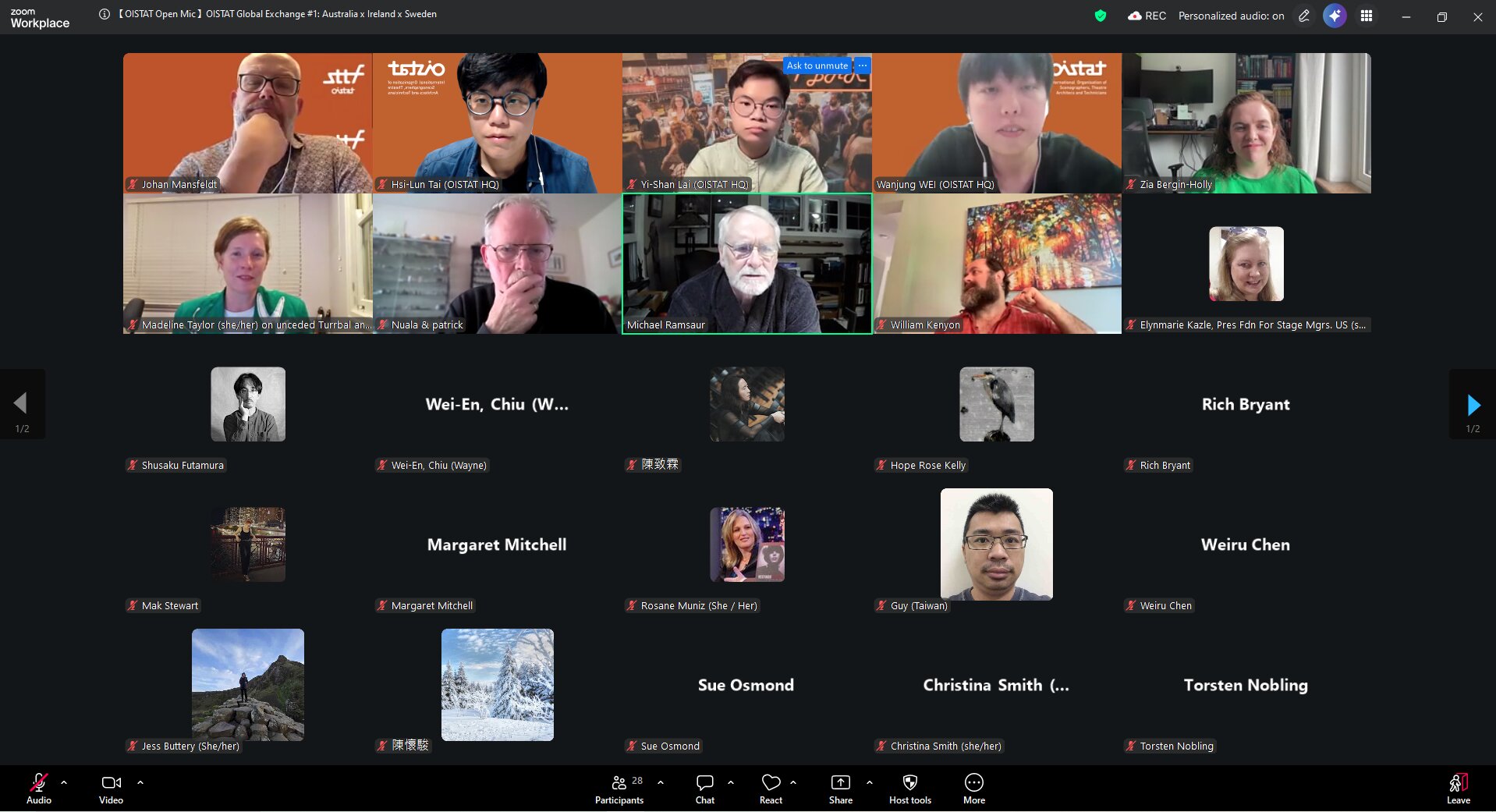
To commemorate the 20th anniversary of the International Organisation of Sceneographers, Theatre Architects, and Technicians (OISTAT) moving its headquarters to Taipei, Taiwan, creative problem-solving is necessary due to its international membership base. In 2006, the organization that “promotes worldwide exchange of ideas and innovations, encourages lifelong learning for live performance practitioners, and fosters international collaboration1 ” moved its headquarters to Taiwan in a monumental step to connect with more theatre practitioners in Asia. 20 years later, the anniversary celebrations are kicking off with their very first OISTAT Global Exchange: a curated series of online panels that introduce OISTAT centres and the wider international theatre landscape while highlighting the value of global collaboration.
As an enthusiastic supporter of my country’s OISTAT centre (shoutout to the United States Institute for Theatre Technology, USITT) and a performing arts administrator, I was excited to learn from other centres around the world. More specifically, I was curious how the panelists from Australia, Ireland, and Sweden would find connection despite their vast distances from one another. What do they have in common? What challenges are they facing, and how do they navigate them? What can we learn from these three countries, and how can we implement their discoveries into our OISTAT centres?
As three different organizations with their own unique history, the similarities that surfaced during the Global Exchange were fascinating. Although not surprising, a common challenge that these organizations navigate within their theatrical ecosystem is funding.
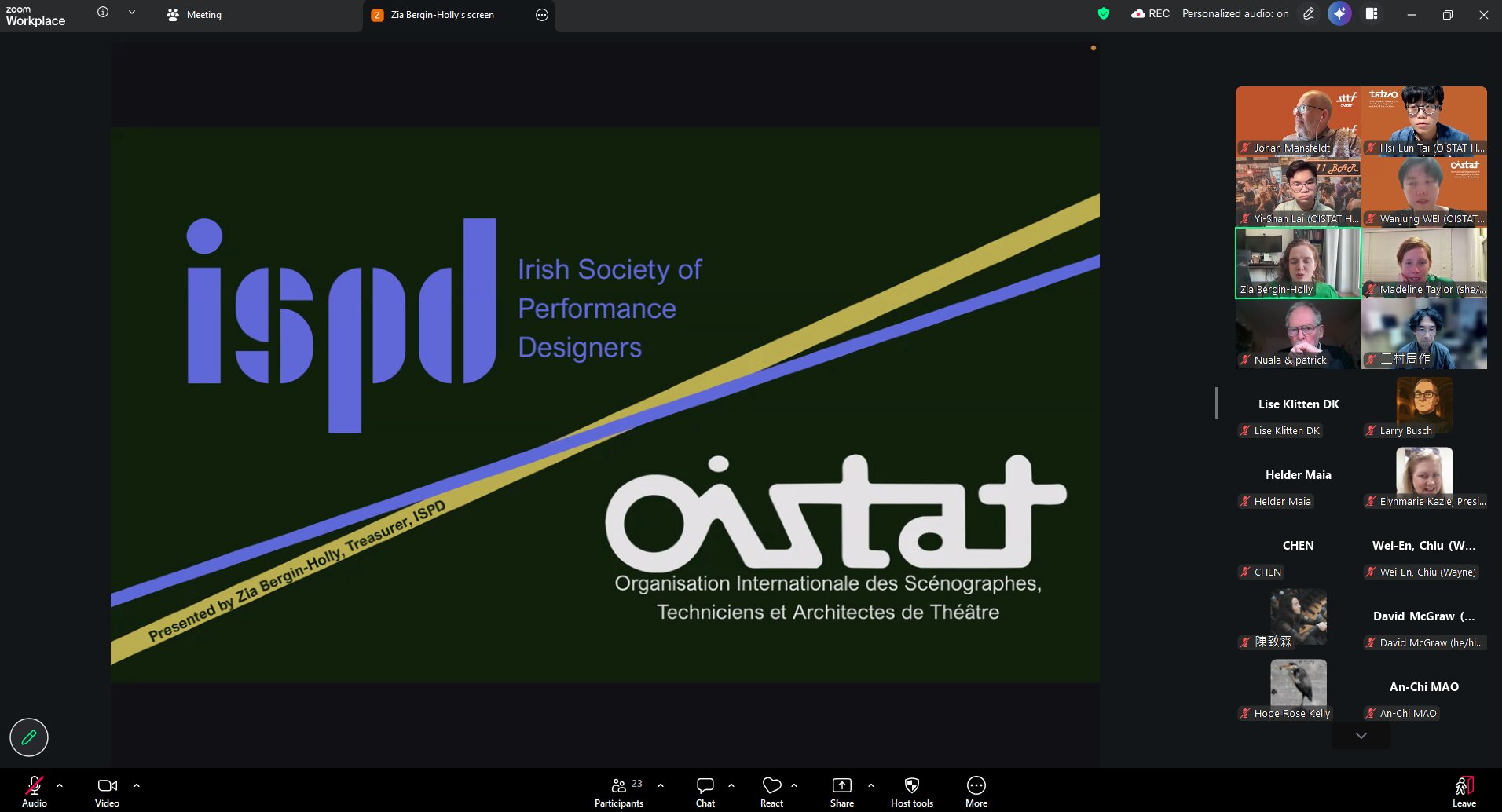
Within the context of the Irish Society of Production Designers (ISPD), Zia Bergin-Holly, the Treasurer, highlighted that funding is typically project-based and, unfortunately, there is insufficient coverage for the rising costs of producing artistic works in Ireland. Madeline Taylor, the Chair of ScenoLab, broke down the funding landscape within Australia into three categories: Major Performing Arts (MPA) Companies that have secured multi-year funding from the Australian Council; state-legislated theatre companies, which receive a mix of state and federal funding; and Small and Medium-size Enterprises (SME)/independent organizations and artists, which is extremely competitive and results in workforce precarity and unpaid creative development. For the latter, if a small or medium organization wants to receive operational funding, they must generate non-grant income that is above $1.6 million. Madeline shared how it’s a catch-222 because the organization can not reach $1.6 million unless they receive the operational funding in the first place. Lastly, Johan Mansfeldt, the Chair of Svensk Teaterteknisk Förening (STTF), which translates to the Swedish Association of Theatre Technicians, shared that Sweden’s theatre industry is struggling. Since the COVID-19 pandemic, STTF has seen a decrease in its membership as people leave the industry to make more money elsewhere. During the exchange, an exasperated Johan said, “Show me the money!” I felt Johan’s words hit a chord within my heart as someone who has been impacted by budget cuts in the performing arts field. As designers, technicians, and administrators, our artistic work has proven time and time again that the performing arts are valuable in people’s lives, and yet the funding does not match this reality.
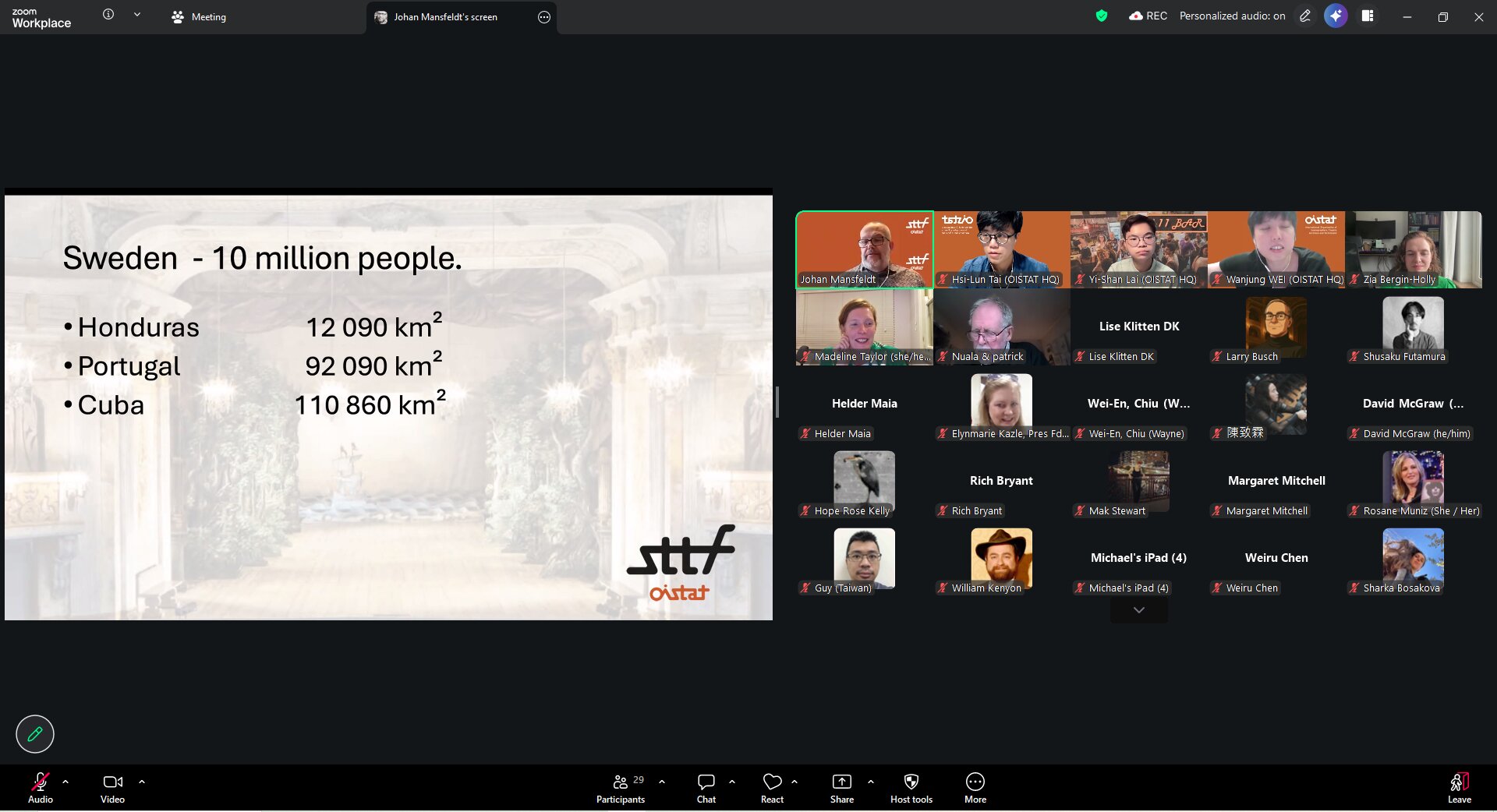
In addition, Sweden and Australia are navigating an educational gap. As mentioned earlier, COVID-19 impacted Sweden’s technical theatre workforce. Now, there is a vast gap in knowledge because skilled technicians have either retired or chosen different careers, and their institutional and in-depth knowledge has not been passed on to new technicians. In Australia, they similarly lack a large workforce of experienced technicians due to COVID-19. As employers shift to hiring technicians part-time rather than as full-time staff members, there is now a discrepancy between employers expecting people to know how to do the job versus employers training employees on the job. On top of that, universities are cutting courses that educate theatre technicians, which will continue to feed into this problem.
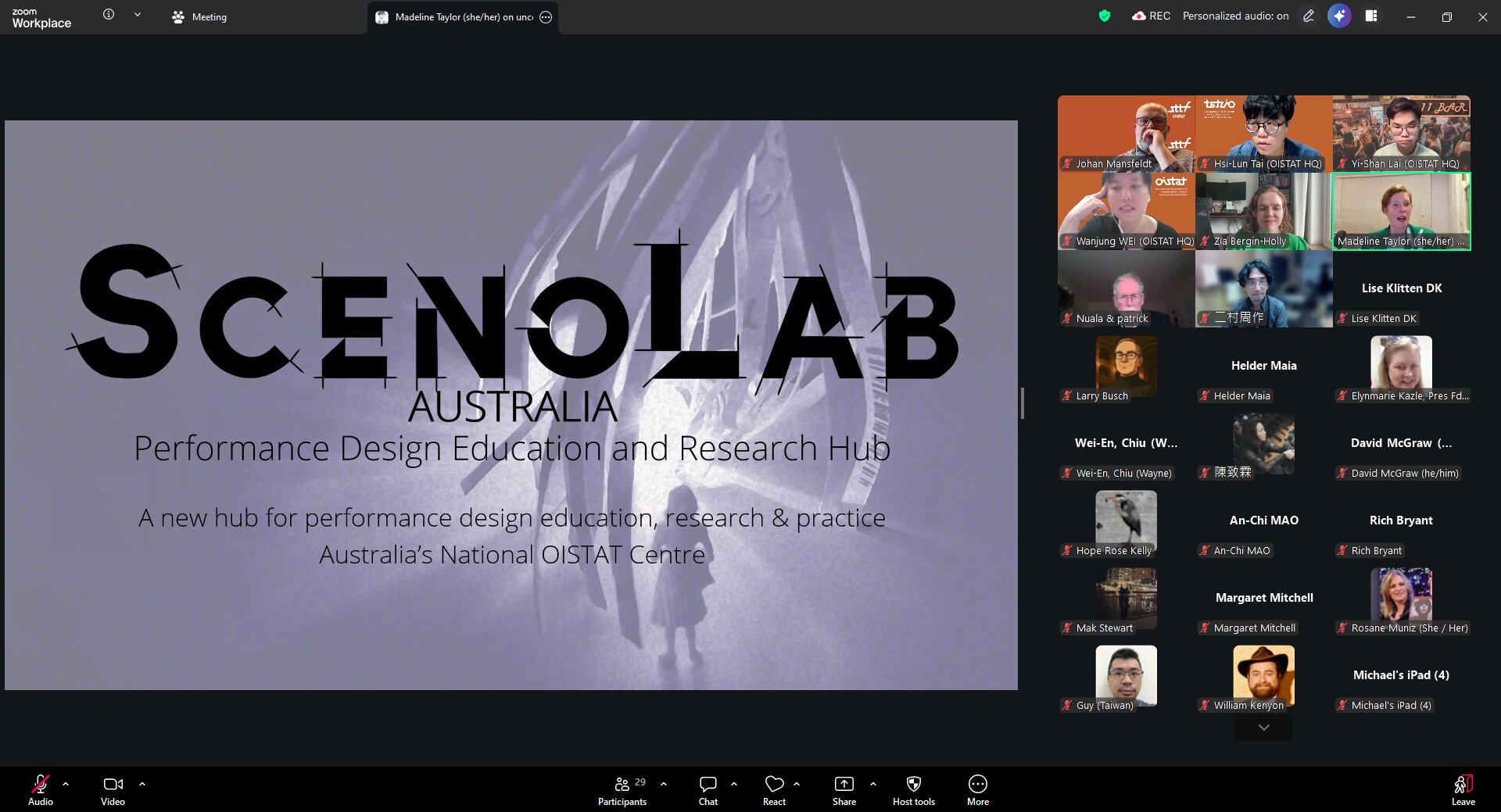
Each organization is finding its own way to fill educational gaps within their membership. In Ireland, they host a professional development podcast called Stage Left. Zia shared that “each Stage Left episode covers [a] different aspect of scenography and its processes with designers from all disciplines at a variety [of] stages of their career”. As someone who is constantly trying to keep up with designers and learn new processes, I appreciate how ISPD is investing in this free professional development resource that connects the Irish community and promotes skill sharing. Meanwhile, ScenoLab’s commitment to fostering the next generation can be seen in its management committee. By having a postgraduate representative each year, the centre is providing an opportunity for these new leaders to listen, watch, learn, and participate in the decision-making process at ScenoLab. In Sweden, STTF publishes a magazine, Magazine Proscen, that informs members of what is happening within the industry, provides technical guides and information on new technology, and features articles written by the theatre community. The OISTAT centre continues to publish and distribute the Magazine Proscen to institutions and individuals who have left STTF due to financial burdens they faced during the pandemic. STTF’s hope is that people will remain engaged with the organization by reading the industry magazine and, hopefully, will return to the OISTAT centre as official members someday.
Despite challenges in funding and education, these OISTAT centres are finding ways to move forward and foster the next generation of talent. Before the session wrapped up, the Executive Director of OISTAT, Wan-Jung Wei, asked the panelists what role OISTAT and its headquarters play in today’s world. Among the three panelists, there was a shared sentiment to continue exchanging ideas together. They encouraged the headquarters to keep facilitating conversations with their members. There is a desire to learn from one another by seeing how policies impact other countries and how OISTAT centres navigate them, as well as to understand how others problem-solve similar challenges.
These panelists are seeking what I also desire: opportunities to learn from others. Going forward, I am excited to see how OISTAT’s headquarters programs opportunities for continual Global Exchange3!
1 The mission is written in the OISTAT Statutes: https://oistat.org/about_oistat.php.
2 catch-22: a situation where someone is prevented from doing one thing until they have done another thing, but they cannot do the first thing that will allow them to do the other thing; for example, when job hunting, you need work experience to get a job but you need a job to get that experience.
3 This article was written during the 2026 Internship Program for OISTAT.
Author’s Biography
Neaco Fox (she/they) is an American-Taiwanese producer, creator, and educator with a passion for mentorship and accessibility in the arts. From 2021 to 2025, Neaco co-managed the United States Institute for Theatre Technology’s (USITT) Gateway Program, a mentorship program for underrepresented populations in the design and technical field of theatre. Before pursuing an International Master's degree in Arts and Creative Industries at Taipei National University of the Arts, Neaco served as the Technical Production Coordinator at Disney Theatrical Group and supported musical productions such as Hercules, Beauty and the Beast, The Lion King, and The Greatest Showman.


